Yale Science Building: Advancing Scientific Innovation Through Integrated Campus Transformation

The Yale Science Building is a flexible interdisciplinary Life Science and Physics research and teaching facility that consolidates previously dispersed science programs into a single highly collaborative environment. Constructed on the site of the former J.W. Gibbs Laboratory, the project revitalizes Yale’s historic Science Hill while preserving land for future campus growth through strategic infill development rather than expansion of the campus footprint.
A New Center for Science Hill
At the heart of the project is the Science Hill Commons plaza, a major new academic and social gathering space that strengthens Yale’s North Campus identity and establishes a prominent destination for students, faculty, and researchers. Integrated indoor/outdoor social, dining, and study environments activate the public realm and reinforce the building’s role as both research infrastructure and campus placemaking catalyst.
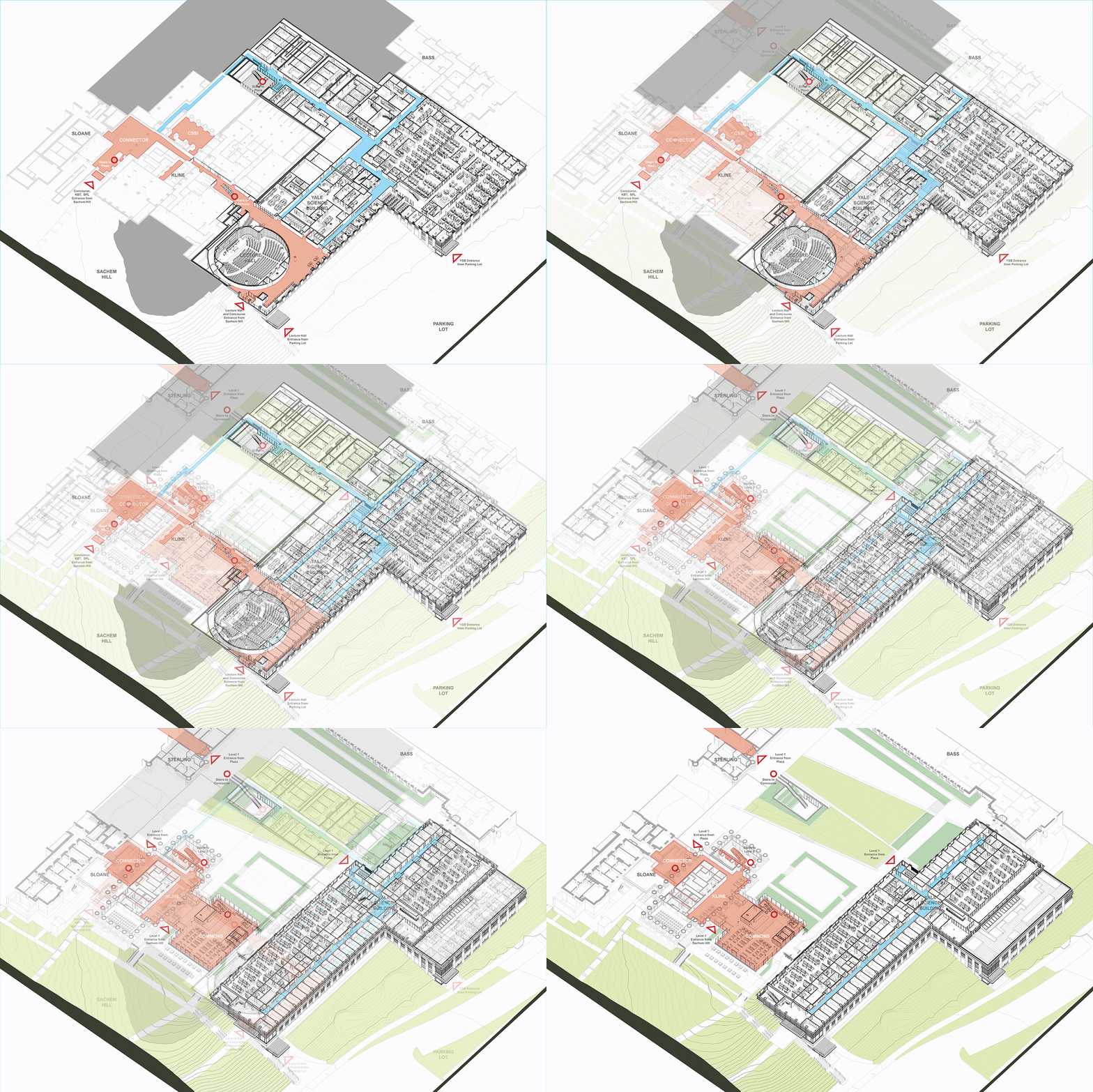
Technically Complex Research Integration and Campus Connectivity
The project leverages a uniquely challenging sloped site to expand and retrofit Yale’s underground concourse network, creating vibration-isolated below-grade physics and imaging laboratories while linking the Yale Science Building to adjacent science facilities. This intervention establishes critical horizontal connectivity across Science Hill and provides expandable infrastructure for future campus development.
“In 100 years, when people look back to this moment, they will see that this building played a vital role in fulfilling our shared vision to accelerate the pace of scientific discovery at Yale to benefit the lives of people around the world.” — Peter Salovey, President of Yale University
High-Performance Research Environment and Sustainability Leadership
Designed as Yale’s most energy-efficient laboratory building, the facility reduces the University’s laboratory EUI benchmark by 25 percent and advances Yale’s path toward net-zero carbon operations. Sustainable strategies include enhanced stormwater management, expanded landscape and green space, and preservation of significant mature oak trees integrated into the site design.
Framework for Future Expansion
Building on the success of the Yale Science Building, the team developed the subsequent Science Hill Northeast Quadrant Master Plan to extend its planning and infrastructure strategies northward for future Physical Sciences and Engineering growth. The master plan expands the below-grade concourse and vibration-free lab infrastructure, integrates new research facilities around Wright Lab, introduces shared service and chemical storage facilities, and organizes new landscaped courtyards that extend the pedestrian-oriented open space framework established by the Yale Science Building.
More About the Project
Project Team
- Fred W. Clarke, FAIA, RIBA, JIA ↗
- Mariko Masuoka, FAIA, LEED AP ↗
- Wesley Wright
- Adam Parkyn
- Blake Mitchell
- Aude Jomini
- Haylie Chan
Principal Collaborators
- Architect of Record: Stantec
- Structural Engineer: Le Messurier
- MEP: Stantec
- Lab Planner: Stantec
- Landscape Architects: Reed Hilderbrand, Stantec, James Corner Field Operations
Project Information
- Location: New Haven, Connecticut, USA
- Client: Yale University
- Size: 282,500 sq. ft. / 26,244 sq. m.
- Completion: 2019
- Certification: LEED Gold
- Firm Role: Design Architect
Awards
- 2021, American Council of Engineering Companies (ACEC/CT) Connecticut Engineering Excellence Awards, Winner
- 2020, Award of Merit for Higher Education/Research, ENR Best Project Award
- 2020, Excellence Award, AIA CT Design Awards
- 2020, American Institute of Architects (AIA) Connecticut Design Awards Excellence, Commercial, Institutional, Educational, and Multi-Family Residential Design
- 2020, American Institute of Architects (AIA) Pittsburgh, Design Pittsburgh Awards, Honor Award, Large
- 2020, Associated General Contractors of Connecticut Build Connecticut Awards, Construction Management/General Contractor: Large New Construction
- Principal Project Photography: Jeff Goldberg/ESTO
Related Projects
-
Singapore, Singapore
-
Bloomington, IN, USA